Blog

Driving Lessons and Instructor Training in Kent England

Powered wheelchairs and mobility scooters

. (36 to 37)

(Called Invalid Carriages in law)
36
There is one class of manual wheelchair (called a Class 1 invalid carriage) and two classes of powered wheelchairs and powered mobility scooters. Manual wheelchairs and Class 2 vehicles are those with an upper speed limit of 4 mph (6 km/h) and are designed to be used on pavements. Class 3 vehicles are those with an upper speed limit of 8 mph (12 km/h) and are equipped to be used on the road as well as the pavement.

37
When you are on the road you should obey the guidance and rules for other vehicles; when on the pavement you should follow the guidance and rules for pedestrians.

On pavements (38 to 40)

38
Pavements are safer than roads and should be used when available. You should give pedestrians priority and show consideration for other pavement users, particularly those with a hearing or visual impairment who may not be aware that you are there.

39
Powered wheelchairs and scooters MUST NOT travel faster than 4 mph (6 km/h) on pavements or in pedestrian areas. You may need to reduce your speed to adjust to other pavement users who may not be able to move out of your way quickly enough or where the pavement is too narrow.
Law UICHR 1988 reg 4

40
When moving off the pavement onto the road, you should take special care. Before moving off, always look round and make sure it’s safe to join the traffic. Always try to use dropped kerbs when moving off the pavement, even if this means travelling further to locate one. If you have to climb or descend a kerb, always approach it at right angles and don’t try to negotiate a kerb higher than the vehicle manufacturer’s recommendations.


3. On the road (41 to 46)

41
You should take care when travelling on the road as you may be travelling more slowly than other traffic (your machine is restricted to 8 mph (12 km/h) and may be less visible).

42
When on the road, Class 3 vehicles should travel in the direction of the traffic. Class 2 users should always use the pavement when it is available. When there is no pavement, you should use caution when on the road. Class 2 users should, where possible, travel in the direction of the traffic. If you are travelling at night when lights MUST be used, you should travel in the direction of the traffic to avoid confusing other road users.
Law UICHR 1988 reg 9

43
You MUST follow the same rules about using lights, indicators and horns as for other road vehicles, if your vehicle is fitted with them. At night, lights MUST be used. Be aware that other road users may not see you and you should make yourself more visible – even in the daytime and also at dusk – by, for instance, wearing a reflective jacket or reflective strips on the back of the vehicle.
Law UICHR 1988 reg 9

44
Take extra care at road junctions. When going straight ahead, check to make sure there are no vehicles about to cross your path from the left, the right, or overtaking you and turning left. There are several options for dealing with right turns, especially turning from a major road. If moving into the middle of the road is difficult or dangerous, you can – stop on the left-hand side of the road and wait for a safe gap in the traffic – negotiate the turn as a pedestrian, i.e. travel along the pavement and cross the road between pavements where it is safe to do so. Class 3 users should switch the vehicle to the lower speed limit when on pavements.

If the junction is too hazardous, it may be worth considering an alternative route. Similarly, when negotiating major roundabouts (i.e. with two or more lanes) it may be safer for you to use the pavement or find a route which avoids the roundabout altogether.

45
All normal parking restrictions should be observed. Your vehicle should not be left unattended if it causes an obstruction to other pedestrians – especially those in wheelchairs. Parking concessions provided under the Blue Badge scheme (see Further reading) will apply to those vehicles displaying a valid badge.

46
These vehicles MUST NOT be used on motorways (see Rule 253). They should not be used on unrestricted dual carriageways where the speed limit exceeds 50 mph (80 km/h) but if they are used on these dual carriageways, they MUST have a flashing amber beacon. A flashing amber beacon should be used on all other dual carriageways (see Rule 220).
Laws RTRA sect 17(2) & (3), & RVLR reg 17(1) & 26

Driving Lessons and Instructor Training in Kent England

Fitness to drive (90 to 94

Fitness to drive (90 to 94

90
Make sure that you are fit to drive. You MUST report to the Driver and Vehicle Licensing Agency (DVLA) any health condition likely to affect your driving.
Law RTA 1988 sect 94
91
Driving when you are tired greatly increases your risk of collision. To minimise this risk

  • make sure you are fit to drive. Do not begin a journey if you are tired. Get a good night’s sleep before embarking on a long journey
  • avoid undertaking long journeys between midnight and 6 am, when natural alertness is at a minimum
  • plan your journey to take sufficient breaks. A minimum break of at least 15 minutes after every two hours of driving is recommended
  • if you feel at all sleepy, stop in a safe place. Do not stop on the hard shoulder of a motorway
  • the most effective ways to counter sleepiness are to drink, for example, two cups of caffeinated coffee and to take a short nap (at least 15 minutes)
92
Vision. You MUST be able to read a vehicle number plate, in good daylight, from a distance of 20 metres (or 20.5 metres where the old style number plate is used). If you need to wear glasses (or contact lenses) to do this, you MUST wear them at all times while driving. The police have the power to require a driver to undertake an eyesight test.
Laws RTA 1988 sect 96 & MV(DL)R reg 40 & sch 8
93
Slow down, and if necessary stop, if you are dazzled by bright sunlight.
94
At night or in poor visibility, do not use tinted glasses, lenses or visors if they restrict your vision.
Driving Lessons and Instructor Training in Kent England

Roundabouts

Roundabouts (184 to 190)

184
On approaching a roundabout take notice and act on all the information available to you, including traffic signs, traffic lights and lane markings which direct you into the correct lane. You should

  • use Mirrors – Signal – Manoeuvre at all stages
  • decide as early as possible which exit you need to take
  • give an appropriate signal (see Rule 186, below). Time your signals so as not to confuse other road users
  • get into the correct lane
  • adjust your speed and position to fit in with traffic conditions
  • be aware of the speed and position of all the road users around you.

185
When reaching the roundabout you should

  • give priority to traffic approaching from your right, unless directed otherwise by signs, road markings or traffic lights
  • check whether road markings allow you to enter the roundabout without giving way. If so, proceed, but still look to the right before joining
  • watch out for all other road users already on the roundabout; be aware they may not be signalling correctly or at all
  • look forward before moving off to make sure traffic in front has moved off.
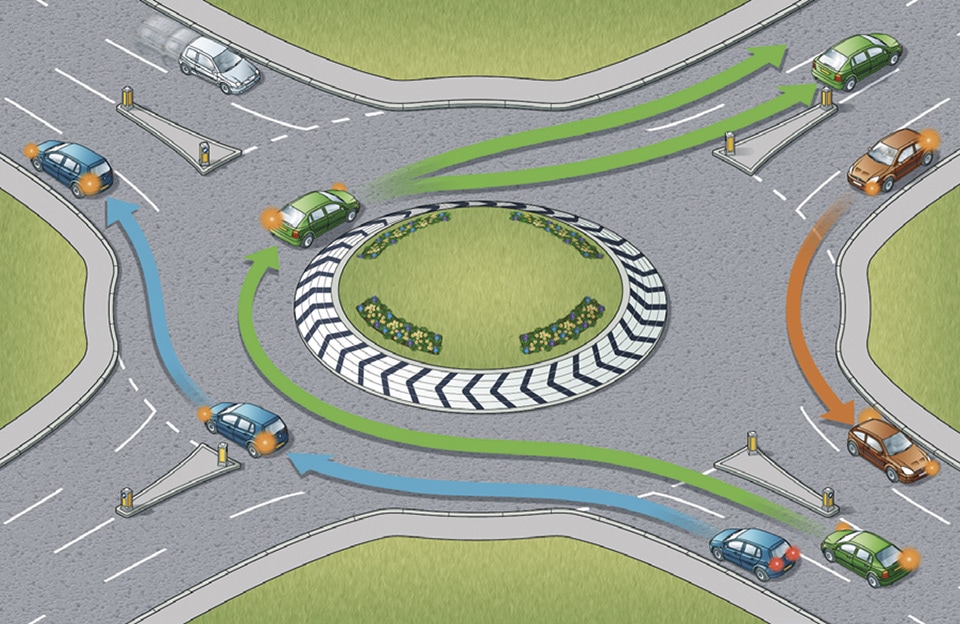
Rule 185: Follow the correct procedure at roundabouts

Rule 185: Follow the correct procedure at roundabouts
186
Signals and position. When taking the first exit, unless signs or markings indicate otherwise

  • signal left and approach in the left-hand lane
  • keep to the left on the roundabout and continue signalling left to leave.

When taking an exit to the right or going full circle, unless signs or markings indicate otherwise

  • signal right and approach in the right-hand lane
  • keep to the right on the roundabout until you need to change lanes to exit the roundabout
  • signal left after you have passed the exit before the one you want.

When taking any intermediate exit, unless signs or markings indicate otherwise

  • select the appropriate lane on approach to and on the roundabout
  • you should not normally need to signal on approach
  • stay in this lane until you need to alter course to exit the roundabout
  • signal left after you have passed the exit before the one you want.

When there are more than three lanes at the entrance to a roundabout, use the most appropriate lane on approach and through it.

187
In all cases watch out for and give plenty of room to

  • pedestrians who may be crossing the approach and exit roads
  • traffic crossing in front of you on the roundabout, especially vehicles intending to leave by the next exit
  • traffic which may be straddling lanes or positioned incorrectly
  • motorcyclists
  • cyclists and horse riders who may stay in the left-hand lane and signal right if they intend to continue round the roundabout. Allow them to do so
  • long vehicles (including those towing trailers). These might have to take a different course or straddle lanes either approaching or on the roundabout because of their length. Watch out for their signals.

188
Mini-roundabouts. Approach these in the same way as normal roundabouts. All vehicles MUST pass round the central markings except large vehicles which are physically incapable of doing so. Remember, there is less space to manoeuvre and less time to signal. Avoid making U-turns at mini-roundabouts. Beware of others doing this.
Laws RTA 1988 sect 36 & TSRGD regs 10(1) & 16(1)

189

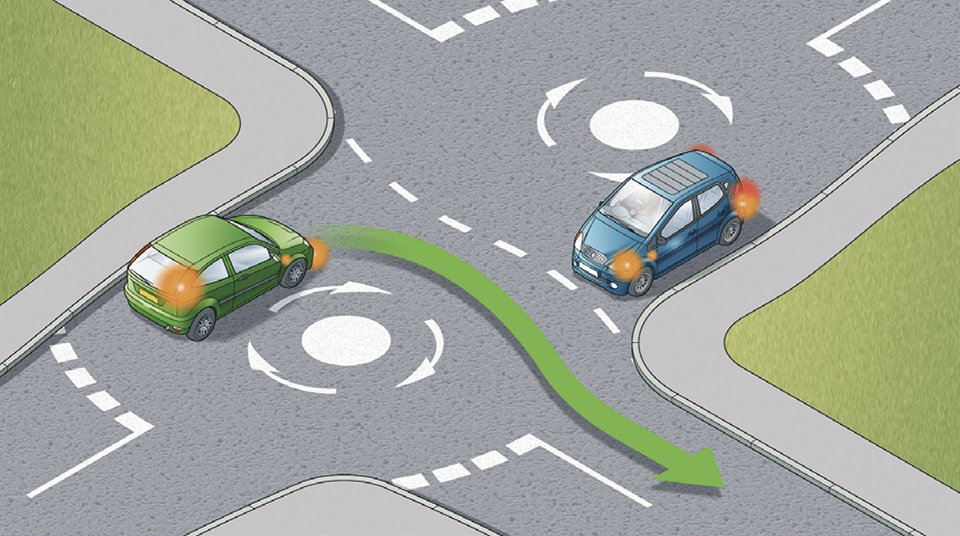
At double mini-roundabouts treat each roundabout separately and give way to traffic from the right.

190
Multiple roundabouts. At some complex junctions, there may be a series of mini-roundabouts at each intersection. Treat each mini-roundabout separately and follow the normal rules.

Rule 190: Treat each roundabout separately

Rule 190: Treat each roundabout separately