
Braking
117
In normal circumstances. The safest way to brake is to do so early and lightly. Brake more firmly as you begin to stop. Ease the pressure off just before the vehicle comes to rest to avoid a jerky stop.
In normal circumstances. The safest way to brake is to do so early and lightly. Brake more firmly as you begin to stop. Ease the pressure off just before the vehicle comes to rest to avoid a jerky stop.
118
In an emergency. Brake immediately. Try to avoid braking so harshly that you lock your wheels. Locked wheels can lead to loss of control.
In an emergency. Brake immediately. Try to avoid braking so harshly that you lock your wheels. Locked wheels can lead to loss of control.
119
Skids. Skidding is usually caused by the driver braking, accelerating or steering too harshly or driving too fast for the road conditions. If skidding occurs, remove the cause by releasing the brake pedal fully or easing off the accelerator. Turn the steering wheel in the direction of the skid. For example, if the rear of the vehicle skids to the right, steer immediately to the right to recover.
Skids. Skidding is usually caused by the driver braking, accelerating or steering too harshly or driving too fast for the road conditions. If skidding occurs, remove the cause by releasing the brake pedal fully or easing off the accelerator. Turn the steering wheel in the direction of the skid. For example, if the rear of the vehicle skids to the right, steer immediately to the right to recover.
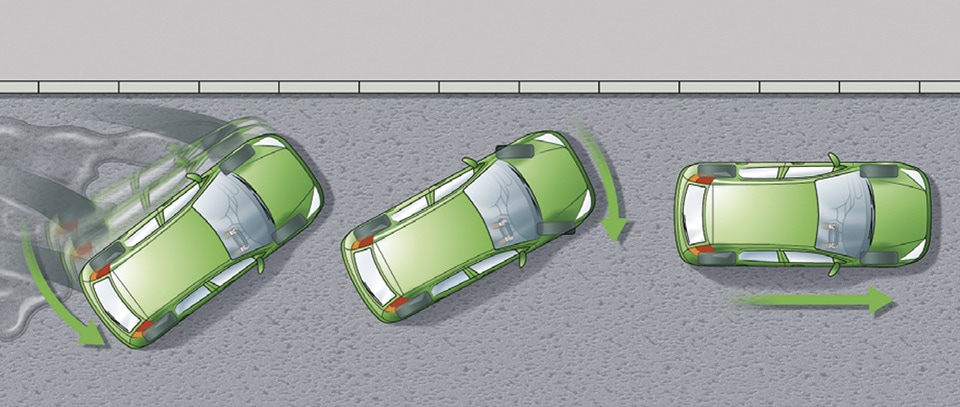
Rule 119: Rear of the car skids to the right. Driver steers to the right
120
ABS. If your vehicle is fitted with anti-lock brakes, you should follow the advice given in the vehicle handbook. However, in the case of an emergency, apply the footbrake firmly; do not release the pressure until the vehicle has slowed to the desired speed. The ABS should ensure that steering control will be retained, but do not assume that a vehicle with ABS will stop in a shorter distance.
ABS. If your vehicle is fitted with anti-lock brakes, you should follow the advice given in the vehicle handbook. However, in the case of an emergency, apply the footbrake firmly; do not release the pressure until the vehicle has slowed to the desired speed. The ABS should ensure that steering control will be retained, but do not assume that a vehicle with ABS will stop in a shorter distance.
121
Brakes affected by water. If you have driven through deep water your brakes may be less effective. Test them at the first safe opportunity by pushing gently on the brake pedal to make sure that they work. If they are not fully effective, gently apply light pressure while driving slowly. This will help to dry them out.
Brakes affected by water. If you have driven through deep water your brakes may be less effective. Test them at the first safe opportunity by pushing gently on the brake pedal to make sure that they work. If they are not fully effective, gently apply light pressure while driving slowly. This will help to dry them out.
122
Coasting. This term describes a vehicle travelling in neutral or with the clutch pressed down. It can reduce driver control because
Coasting. This term describes a vehicle travelling in neutral or with the clutch pressed down. It can reduce driver control because
- engine braking is eliminated
- vehicle speed downhill will increase quickly
- increased use of the footbrake can reduce its effectiveness
- steering response will be affected, particularly on bends and corners
- it may be more difficult to select the appropriate gear when needed.

 LDLT Driving School